Inputs
KSeF invoices and your balance
Sales and purchase invoices come from KSeF. You type in today's bank balance and payments outside KSeF; salaries, ZUS and taxes are suggested from your P&L.

Virtual CFO for SMEs
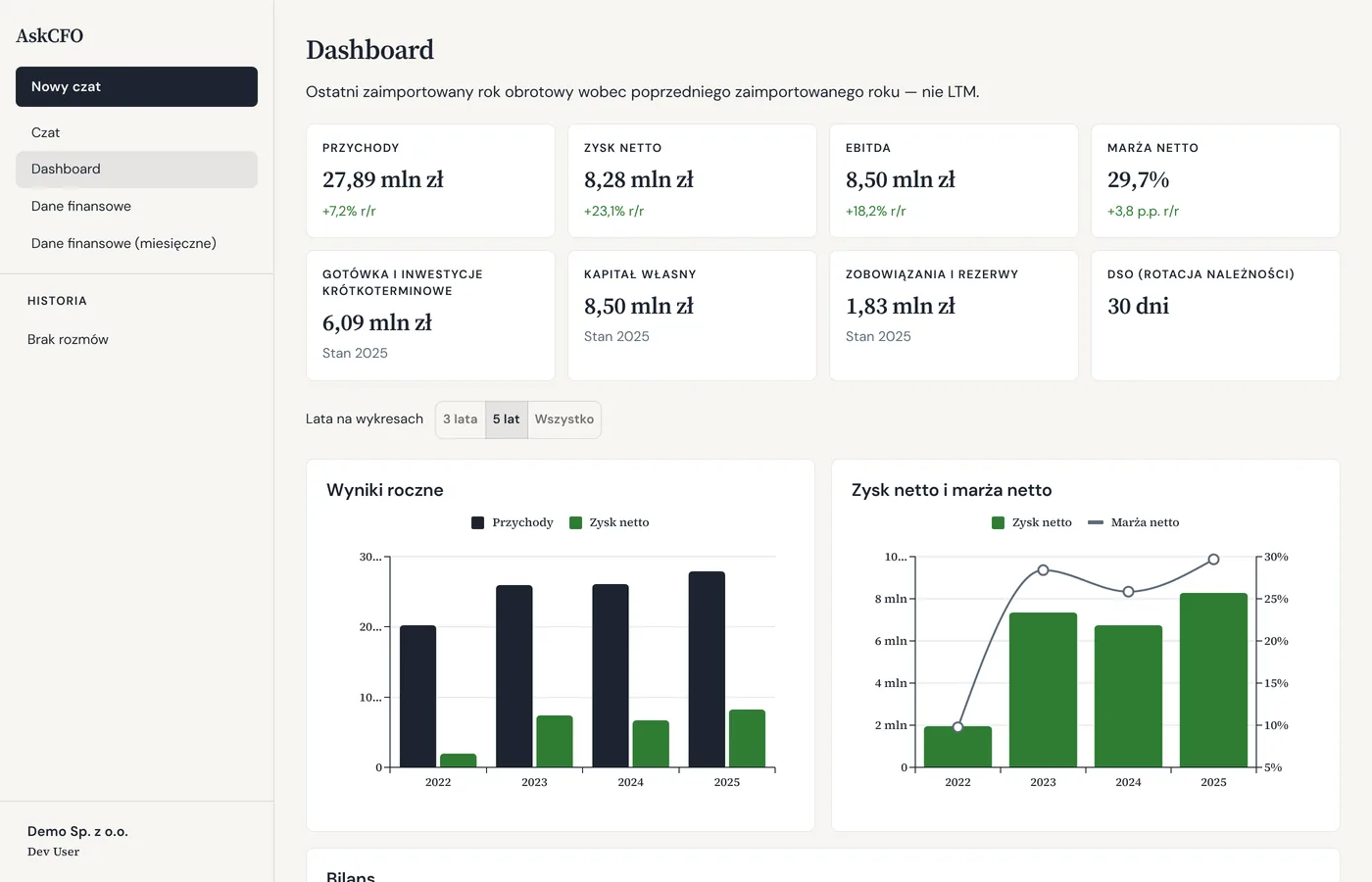
AskCFO reads your company's financial statements, shows what the company is worth today and after optimization, and answers questions like a finance director, without a full-time CFO salary.
Cash flow
AskCFO forecasts your bank balance day by day for 60 days: from sales and purchase invoices in KSeF, the balance you type in, recurring payments, and ZUS, PIT, CIT and VAT on their statutory dates. You see the low point before you get there.
Daily balance, 2 × 30 days
Illustrative example
Inputs
Sales and purchase invoices come from KSeF. You type in today's bank balance and payments outside KSeF; salaries, ZUS and taxes are suggested from your P&L.
Calculation
Due dates come from the invoice or the counterparty's usual term, corrections are folded into their invoices, and VAT is output minus input from KSeF. You can delay a customer or shift a payment and see the effect at once.
What to do
Room to spare, below buffer, on overdraft or short even with overdraft. Ask the AI CFO what to do: it answers with specific invoices, customers and payment dates.
Valuation
AskCFO values your company from its e-KRS statements twice: as it runs today, and as it could run with better margins and working capital. The gap between the two is value you can still build.
Equity value at the valuation date
Example from the AskCFO panel
Static valuation
The five-year projection keeps last year's revenue growth, cost structure and payment terms. This is the value of the company as it runs today.
Dynamic valuation
Revenue grows faster, cost ratios fall, customers pay sooner, inventory turns quicker and supplier terms lengthen, year after year. You set the pace of each improvement.
Value gap
The difference in PLN and in percent. Change an assumption and both valuations and the gap are recalculated at once.
Product
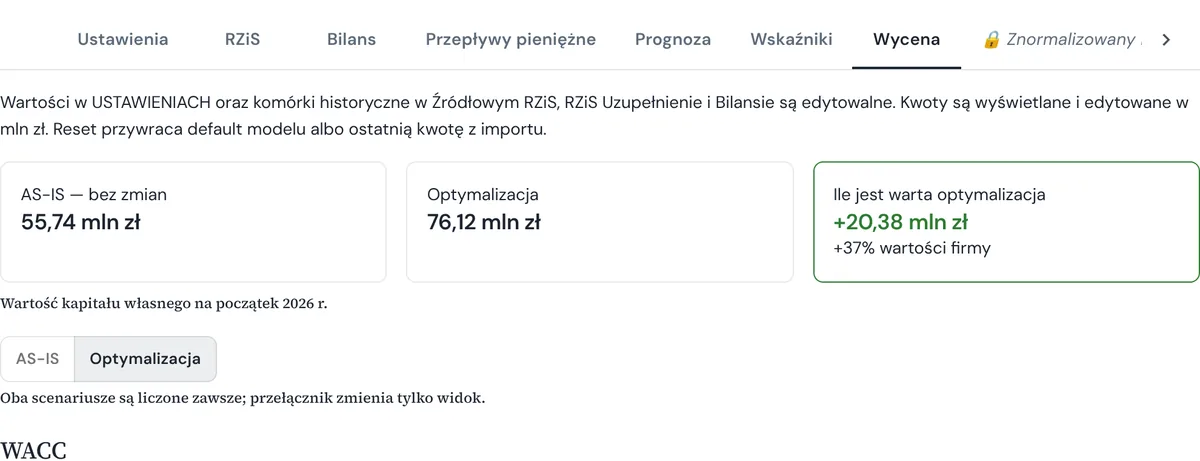
Static and dynamic value side by side, with the gap in PLN and percent.
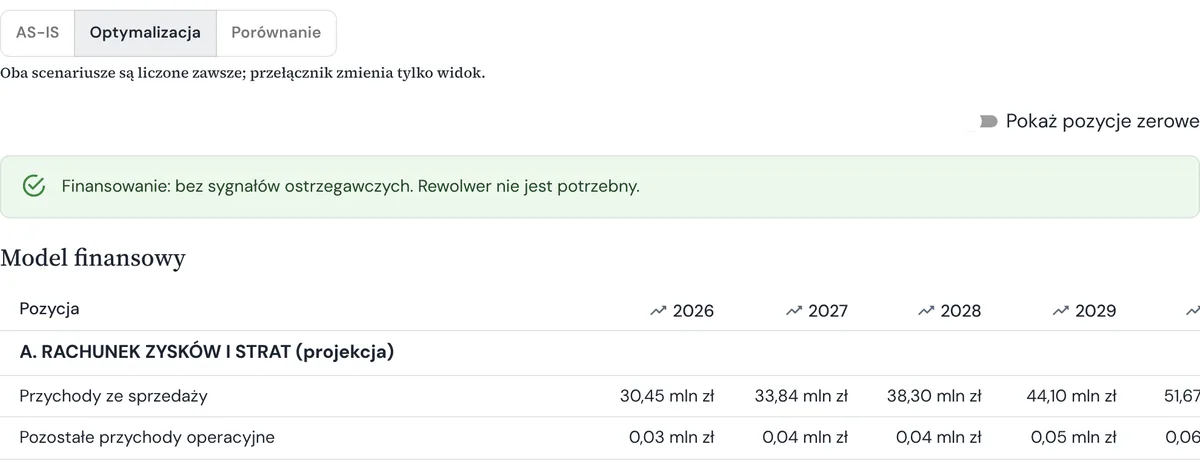
Projected P&L, balance sheet and cash, with warnings when financing runs short.
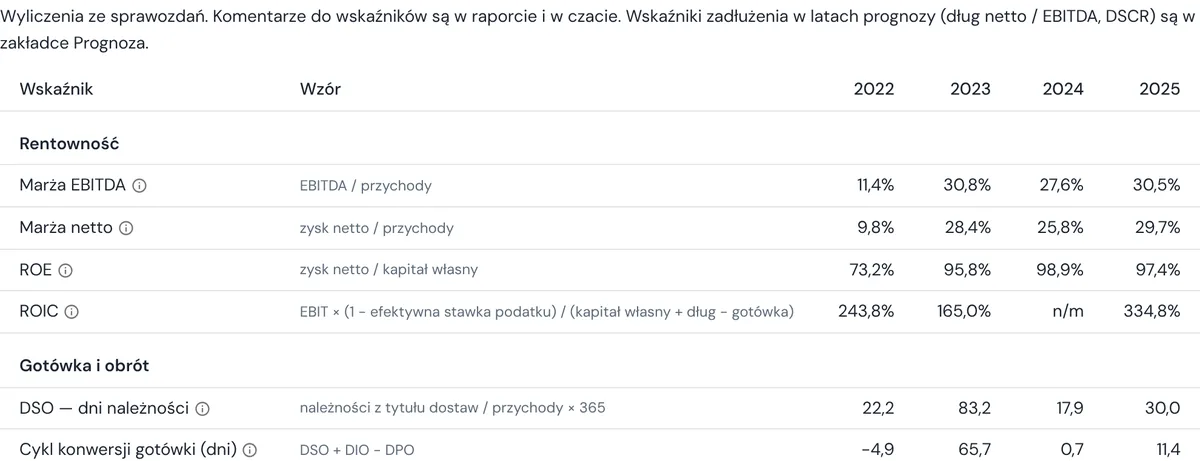
Profitability, cash cycle and debt ratios, each with the formula behind it.
Features
DCF and EVA valuation with WACC built from CAPM, a liquidity discount and a terminal growth rate.
Two scenarios side by side, so you can see what better margins and working capital do to results and value.
Chat with an AI CFO that knows your company's numbers. Answers come with tables and charts, not generic advice.
Plan investments year by year and see the effect live: revolver, debt limit, dividend and cash buffer.
Funding gaps, negative equity and the Article 233 KSH loss threshold are flagged before they become a problem.
Margins, ROE, ROIC, DSO and DIO, cash conversion cycle, net debt to EBITDA and Altman Z-score.
Upload e-KRS XML or ZIP statements, up to 36 files at once. Monthly data comes in from Excel, XML or PDF.
Normalized historical statements and a five-year projection, in PLN, thousands or millions.
Connect AskCFO to Claude or ChatGPT with an MCP connector and ask about your company from there. Claude also gets a dedicated plugin.
Technology
Excel is made for people clicking cells, not for AI agents. Hidden references, cached results and #REF! errors make a spreadsheet hard for a model to read and hard to audit. So the AskCFO financial model runs on FinLang, our own formula language.
Data sources
AskCFO engine
FinLang
if(value("pnl.revenue") = 0,
   null,
   value("pnl.ebit")
/ value("pnl.revenue"))AI agents
FinLang has no variables, loops or side effects. Every formula is parsed and checked against an allowlist of model rows before it runs.
Ratios, projection and valuation are readable expressions over 2022 to 2030, so the AI explains a result instead of guessing it.
The same engine answers in the AskCFO chat and through MCP tools in Claude and ChatGPT. Figures come straight from the engine, so the model does not calculate them itself.
Company data is stored in the EU. AI models in the AskCFO chat run on EU endpoints with zero data retention (ZDR), so providers do not keep your data or train on it.
We open accounts after reviewing each request. Leave your details and we will get back to you.